
Laser Therapy

What is Summus Medical Laser Therapy?

Laser treatments enhance blood circulation and lymphatic drainage; release oxygen and nutrients from the bloodstream into the tissues and improve cellular metabolic activity to produce more cellular energy. With more energy available, damaged cells can repair and regenerate more quickly, and with better quality. 

THE HISTORY OF LASER THERAPY

Albert Einstein first envisioned the concept of light amplification by the stimulated emission of radiation (LASER) in 1917. However, it was not until 1960 that the first laser was built by Theodore Maiman,, It was another 25 years or so before technology advanced enough to make lasers safer, easier to use, and cost effective. Dr. Endre Mester is credited with the discovery of the biostimulative properties of red and near infrared light. He stumbled upon this during an experiment designed to determine if lasers might cause cancer. They did not, and in fact helped the shaved mice grow hair back more quickly.

Compared to ordinary light, laser light eaves are synchronized. The peaks and troughs of the waves match up in a phenomenon called coherence. Laser light can be collimated with a lens, as demonstrated by a laser pointer, whereas ordinary light spreads out in all directions.

Finally, laser light is monochromatic – it is of one wavelength or color (+/- a few nanometer due to diode production). It is this characteristic that is responsible for a laser’s specificity and selective effect on tissue.

Common Questions regarding Neuropathy and Laser Therapy

What are the Symptoms of Neuropathy?

Some symptoms include

  • Weakness
  • Pain
  • Numbness
  • Tingling

People who tend to be prone to neuropathy include those who:

  • Have autoimmune disorders
  • Have diabetes
  • Go through chemotherapy
  • Are senior citizens.

Laser therapy treats pain in many areas and for many different ailments, including:

  • Tendinopathies
  • Carpal Tunnel
  • Tennis Elbow
  • Neck Pain
  • Rib Pain
  • Muscle Strains
  • Osteoarthritis
  • Fibromyalgia
  • Sports Injuries
  • And much more

Laser therapy promotes the regeneration of healthy tissues by increasing the circulation of the problem area. This allows more water, oxygen, and nutrients to flow into the affected area. Ultimately, the influx of the nutrients reduces swelling, inflammation, stiffness, and more.

Nope. Most patients don’t even feel a thing. You may feel the concentrated area warm up, but no unpleasant or painful feeling.

The number of treatments depends on the severity of your pain. After an initial consultation or two, we will evaluate the best course of action to get you feeling better in no time.

Yes. We will include other restorative procedures and items in your care plan. We want to ensure that you’re healthy and feel great.
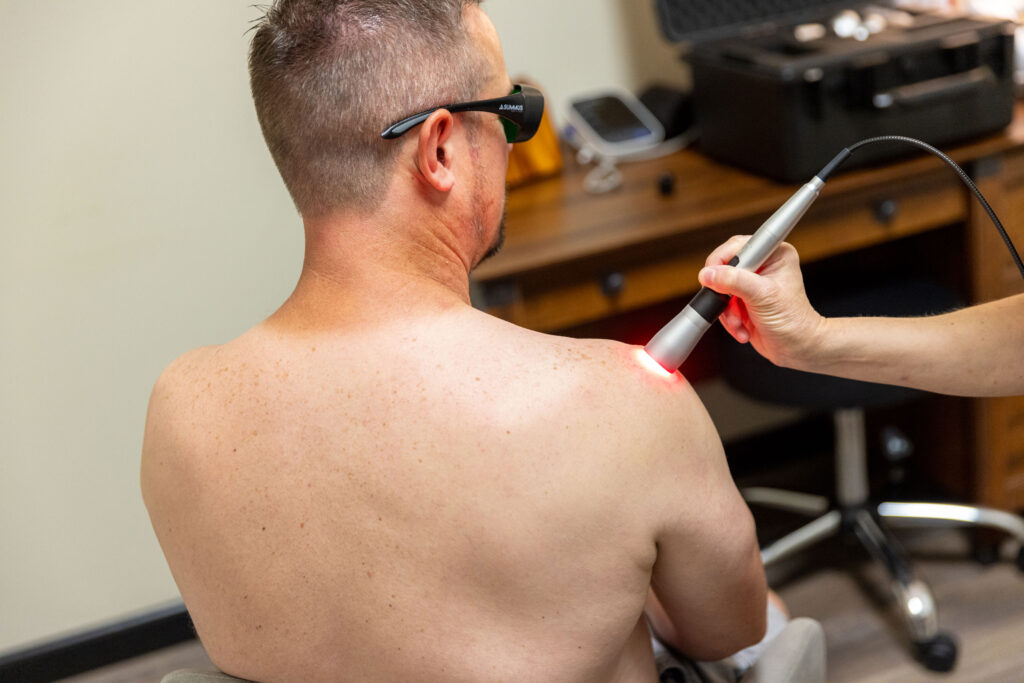
Benefits of Laser Therapy

Benefits of Class IV Therapeutic Laser

Laser treatments enhance blood circulation and lymphatic drainage; release oxygen and nutrients from the bloodstream into the tissues and improve cellular metabolic activity to produce more cellular energy. With more energy available, damaged cells can repair and regenerate more quickly, and with better quality.

Accelerated Tissue Repair and Cell Growth

Photons of laser light penetrate deeply into tissue and accelerate cellular reproduction and growth. The laser light increases the energy available to the cell so that the cell can take on nutrients faster and get rid of waste products. As a result, the cells of tendons, ligaments, bone, nerves, and muscles are repaired faster.

Faster Wound Healing

Laser therapy stimulates fibroblast development (fibroblasts are the building blocks of collagen, which is predominant in wound healing) in damaged tissue. Collagen is the essential protein required to replace old tissue or to repair tissue injuries. As a result, laser therapy is effective on open wounds, scars, and burns.

Reduced Fibrous Scar Tissue Formation

Laser therapy reduces the formation of scar tissue following damage from cuts, scratches, burns or surgery by inducing production of more normal type-1 collagen. Scar tissue is the primary source of chronic pain. Laser treatments should be given as soon as possible after any acute injury to promote type-1 collagen production and parallel alignment of the collagen fibers.

Modulating Inflammation

Laser treatments modulate inflammation by causing vasodilation and activating the lymphatic drainage system. As a result, there is a reduction in swelling caused by bruising or inflammation. Try not to say that laser treatments are “anti-inflammatory”, as they do not suppress inflammation as non-steroidal anti-inflammatory drugs (NSAIDs) do. Rather, Class IV laser therapy treatments help the body progress through the stages of inflammation more efficiently. 

Analgesia

Laser therapy can reduce the firing of the C-pain fibers that transmit signals of “pain” from the cells to the brain. Increased blood circulation flushes away tissue irritants called “kinins”. Pain modulating chemicals such as endorphins and enkephalins are released from the brain and adrenal gland. Increased cell membrane permeability encourages normal concentrations of ions across the cell membrane, and the resting potential of pain fibers is returned to -70 millivolts.

Improved Vascular Activity

Laser therapy will significantly increase the formation of new capillaries in damaged tissue that speeds up the heling process, closes wounds quickly and reduces scar tissue. Additional benefits include acceleration of angiogenesis, which causes temporary vasodilation, an increase inn the diameter of blood vessels. More blood flow equals faster healing and less pain. 

Improved Nerve Function

Slow recovery of nerve functions in damaged tissue can result in numbness and impaired limbs. Laser therapy will speed up the process of nerve cell reconnection and increase the amplitude of action potentials to optimize muscle action.

Immune System Regulation

Laser therapy can both increase the local immune system response as well as have a positive effect on the whole-body immune response. Increased circulation and enhanced cellular energy production will enhance the activity of immune system cells, helping to reduce and fight infection.

Trigger Points and Acupressure Points

Laser therapy reduces muscle trigger points and stimulates acupuncture points on a non-invasive basis providing musculoskeletal pain relief.